Form 990 research for reporters: how to find and read a nonprofit’s tax return
Find a nonprofit’s Form 990 through IRS search, ProPublica, Candid or a state office, then read the parts that matter. This guide uses the 2025 form year. Each link was checked in October 2026.
On this page
- What does a Form 990 cover?
- Start here
- Which form did the organization file?
- How do you find a nonprofit’s 990 in five steps?
- What can you ask the organization for?
- How do state charity regulators fit in?
- How do you read a Form 990, part by part?
- What does a worked example look like?
- Which schedules matter to a reporter?
- What does a Form 990 not tell you?
- Reporting checks
- Sources
What does a Form 990 cover?
A Form 990 reports an organization’s mission, programs, governance, pay and finances, and an officer signs it under penalties of perjury.
The IRS publishes the form and its instructions. Part II of the form carries the signature block. It reads, “Under penalties of perjury, I declare that I have examined this return.” The Instructions for Form 990 (2025) add, “Some members of the public rely on Form 990 or 990-EZ as their primary or sole source of information about a particular organization.”
That is why reporters read it. The return is the organization’s own account, filed with the IRS, of how it raised and spent money. Treat it as a claim you test, not a verdict. The Beat Reporting Guides list the IRS search and ProPublica in one row. This guide goes deeper. For SEC filings and other company records, use the Business Beat Guide.
This guide uses the Form 990 (2025) and its instructions, the current IRS versions as of October 2026. A return you find may use an older form. Read the form year in the header of any return, and check each line number against that year’s form before you cite it.
Federal FOIA covers federal agencies, not a private nonprofit. To get a 990 from the organization, rely on the tax-law inspection rules in the section on requests below. Records that a government agency holds about a nonprofit, such as grant files, fall under public records laws. The FOIA and public records guide covers that route.
Start here
Start with these six pages. They cover the IRS search, ProPublica, the IRS instructions and form, a nonprofit data service and the state regulator directory.
IRS Tax Exempt Organization Search
The IRS database of Form 990 series returns, Form 990-N notices, Publication 78 data and determination letters.
ProPublica Nonprofit Explorer
Search an organization, a person or the full text of filings. Links to PDF and XML copies where they exist.
Instructions for Form 990 (2025)
The IRS line-by-line instructions. Use them for filing thresholds, pay definitions and public inspection rules.
Form 990 (2025)
The blank form. Read it once so you know every part before you open a real return.
Candid: Finding 990s and 990-PFs (Nonprofit, paid plans)
Candid’s how-to page for finding returns and requesting copies. Candid describes itself as a nonprofit and sells paid plans beside its free search.
NASCO: state government directory
The National Association of State Charity Officials lists the state offices that regulate charities.
Which form did the organization file?
The form you find depends on the organization’s size and type, so check the form number before you read any dollar figure.
The table below follows the Instructions for Form 990 (2025) unless a row names another source. Gross receipts are the total received from all sources before subtracting costs.
| Form | Who files it | What you get |
|---|---|---|
| Form 990 | Gross receipts of $200,000 or more, or total assets of $500,000 or more at year end | The full return, Parts I to XII, with schedules |
| Form 990-EZ | An organization with gross receipts under $200,000 and total assets under $500,000 may choose it | A shorter return with its own instructions |
| Form 990-N (e-Postcard) | An organization whose gross receipts are normally $50,000 or less, if it does not file a 990 or 990-EZ | No financial details, according to ProPublica |
| Form 990-PF | Private foundations, per the IRS Form 990-PF page | The foundation return, a different form |
| No return | Churches, integrated auxiliaries, conventions or associations of churches | Nothing to find. See Section B of the instructions |
Churches are the most common dead end. The instructions list “a church, an interchurch organization of local units of a church, a convention or association of churches, or an integrated auxiliary of a church” among the organizations that do not have to file. The IRS churches page says churches and some other types of organizations are excepted from filing. The Find Experts and Sources page notes the same limit.
Timing follows a fixed rule. The instructions set the due date at the 15th day of the 5th month after the accounting period ends, which is May 15 for a calendar-year filer. A weekend or holiday moves it to the next business day. An organization can ask for more time on Form 8868. Apply that rule before you call a return late.
How do you find a nonprofit’s 990 in five steps?
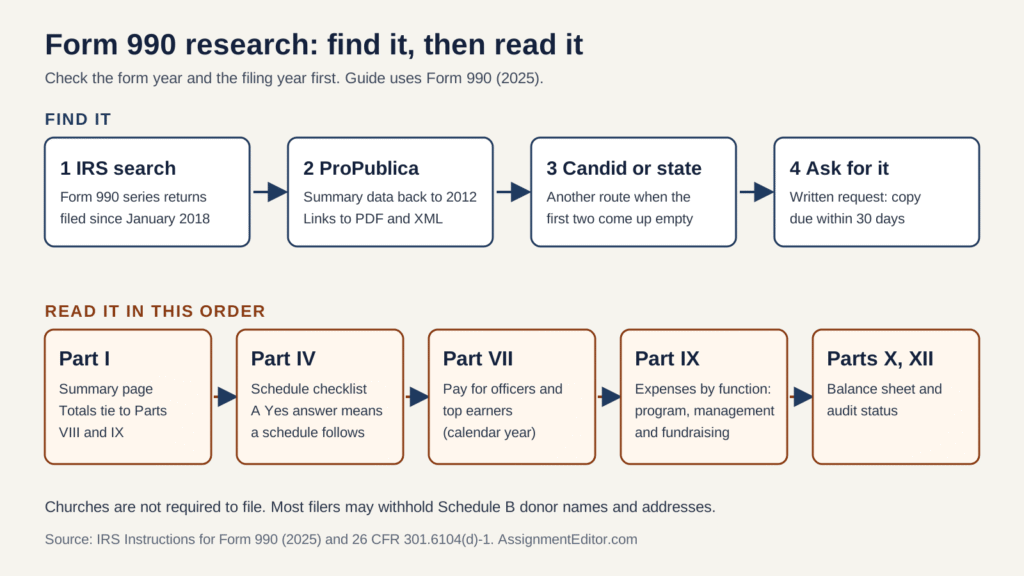
Search the IRS database first, then ProPublica, then Candid or a state office, and ask the organization if the return is still missing.
- Get the exact legal name and the EIN. The IRS search matches only the legal name or “doing business as” name on file. Put the name in quotes. The dash in an EIN is optional, per the IRS search tips.
- Search the IRS Tax Exempt Organization Search. The IRS copies page says you can view returns free of charge and search individual Form 990-series returns “filed since January 2018” there. As of October 2026, the IRS search-tips page lists its latest Form 990 series data posting as August 27, 2026.
- Open ProPublica Nonprofit Explorer. Its summary data covers returns the IRS processed since the 2012 calendar year, plus limited older records. It links to the PDF of the full return and, for electronically filed returns, the XML. It can also email you when new data arrives for an organization you follow.
- Try Candid (Nonprofit, paid plans) and your state charity office. Either may help when the IRS search comes up empty.
- Ask for it. Write to the organization. Or send the IRS Form 4506-A, which the IRS asks you to use only after checking the search tool first.
| Source | What it gives you | Limit to know |
|---|---|---|
| IRS Tax Exempt Organization Search | Form 990 series returns, Form 990-N, Publication 78, the Auto-Revocation List and determination letters | Returns filed since January 2018. Name must match the IRS record |
| IRS bulk downloads | Monthly data files, including Form 990 series XML | Full data sets for download. Latest Form 990 series XML posting listed August 20, 2026 |
| ProPublica Nonprofit Explorer | Search by organization, person or full text. PDF and XML links | Summary data is a subset of the full return. XML only for e-filed returns |
| Candid (Nonprofit, paid plans) | Organization profiles and linked returns | Candid says the latest return can take a year to 18 months to reach the web |
| State charity office | Registration records and annual reports | Rules differ by state. Check your state’s law and office |
| The organization | A copy or an inspection | Rules in 26 CFR 301.6104(d)-1, below |
The lag is real, and two sources say so. Candid says “it can take a year to 18 months from the end of an organization’s fiscal year to when its latest Form 990 is available online.” The Library of Congress nonprofit guide describes the same 12 to 18 month delay.
ProPublica warns about depth: “This data release includes only a subset of what can be found in the full Form 990s.” Open the PDF for anything the summary does not show.
What can you ask the organization for?
A tax-exempt organization must make its annual return available for public inspection, and must provide copies unless it posts the return online.
The Instructions for Form 990 (2025) say section 6104 requires an organization to make its returns available for inspection and either provide copies on request or make them “widely available” on the Internet. Even then, it must still allow inspection. Appendix D of the instructions explains what counts as widely available.
As of October 2026, 26 CFR 301.6104(d)-1-1) sets these rules:
- In person at a principal, regional or district office, the organization must give you copies on the day you ask, unless unusual circumstances exist. Then the deadline is no later than the fifth business day after the request.
- A written request can go by mail, email, fax or private delivery to one of those offices. It must give the address for the copy.
- The organization must mail the copy within 30 days of receiving the request. If it requires payment in advance, the 30 days run from payment.
- You can ask for a specific part or schedule. A request for less than the whole return must name the part.
- The fee may not exceed the per-page copying charge in the FOIA fee schedule plus actual postage. Without prepayment, the organization needs your consent before it provides copies costing more than $20.
- The organization must keep each return available for three years from the due date or filing date, whichever is later.
- If you inspect in person, the organization may have an employee in the room. You may take notes freely.
- If the organization denies a valid request, you may send the IRS a statement describing why you believe the denial broke the rule.
The IRS is a second route. The IRS copies page says all requests must be in writing on Form 4506-A, or on letterhead for requests from members of the media. The page says to mail or fax the form, says requests are not accepted by telephone or email, and warns you may be billed for photocopying.
Keep every request in writing and log the dates, as the FOIA guide advises for records requests. This page explains how reporters use the rules. It is not legal advice.
How do state charity regulators fit in?
State charity offices keep their own registrations and filings, and the rules differ from state to state.
The National Association of State Charity Officials (NASCO) lists the state offices. NASCO’s home page says registration and filing requirements differ from state to state. Check your state’s law before you rely on a state file.
Two examples show the range:
- New York: the Attorney General’s Charities Bureau says charities must register and file annual financial reports. Its charities search lets you read annual financial reports. Reports filed in the last five years are available once reviewed. For older ones, the office says to submit a FOIL request.
- California: the Attorney General’s charities page says the Registry Search Tool lets the public view and download a registrant’s public filings, including copies of IRS Forms 990, 990-PF and 990-EZ.
New York’s search shows whether a charity is registered, and California’s registry can hold a copy of the IRS return. Note the source and date of each copy in your notes.
So far you know which form to expect, where to look and how to ask when a return is missing. The rest of this guide covers how to read the return once you have it.
How do you read a Form 990, part by part?
Start with the Part I summary, then use the Part IV checklist to see which schedules to open.
Part I is the front page, and it pulls its figures from later parts. The instructions tell the filer to complete lines 3 to 5 and 7 to 22 by using the references to other items. On the form, line 12 total revenue must equal Part VIII, column A, line 12. Line 18 total expenses must equal Part IX, column A, line 25. Always check the summary against the part it points to.
Part I: the summary
Line 12 is total revenue. Line 18 is total expenses. Line 19 is revenue less expenses. Line 20 is total assets from Part X, line 16. Line 21 is total liabilities from Part X, line 26. Line 22 is net assets. Line 5 counts total individuals employed, and line 6 counts volunteers.
Part III: programs
Part III asks for the mission and describes the three largest program services as measured by expenses. Read it for what the organization says it does.
Part IV: the schedule checklist
Each Yes on Part IV triggers a schedule. The table in the next section lists the ones reporters use most.
Part VI: governance
Line 1a counts voting members of the governing body. Line 1b counts those who are independent. Line 2 asks about family or business relationships among officers, directors, trustees and key employees. Line 5 asks whether the organization became aware of a significant diversion of its assets. Line 12a asks about a written conflict of interest policy and line 13 about a written whistleblower policy. The form tells the filer to describe each Yes on lines 2 through 7b on Schedule O. Read Schedule O when a Yes appears.
Part VII: pay
Part VII lists current officers, directors, trustees and key employees, the five highest compensated employees paid more than $100,000, and certain former officers and employees. It reports compensation for the calendar year ending with or within the organization’s tax year. Reportable compensation generally comes from box 1 or 5 of Form W-2, box 1 of Form 1099-NEC and box 6 of Form 1099-MISC. A Yes on lines 3, 4 or 5 sends the filer to Schedule J.
Do not match Part VII to the expense total without checking the period. The instructions say the amount in Part VII “may differ” from Part IX, line 5, for the same person because of a different accounting period or method.
Parts VIII, IX and X: money
Part VIII reports revenue. Part IX reports expenses in four columns: (A) total, (B) program service, (C) management and general, and (D) fundraising. Part X is the balance sheet. It gives total assets on line 16, total liabilities on line 26 and total net assets on line 32.
The instructions define program services as “mainly those activities that further the organization’s exempt purposes.” They also say that if the accounting system does not allocate expenses, the organization “can use any reasonable method of allocation.” The split between columns is the organization’s own classification. Ask how it allocated before you quote a program percentage as a fact.
Part XII: audits
Line 2a asks whether an independent accountant compiled or reviewed the financial statements. Line 2b asks whether an independent accountant audited them. Line 3a asks whether a federal award required an audit under the Uniform Guidance, 2 CFR Part 200, Subpart F. Line 3b asks whether it was done.
Check the threshold in current rules. As of October 2026, 2 CFR 200.501 requires a single or program-specific audit when an organization expends $1,000,000 or more in federal awards in its fiscal year. The Federal Audit Clearinghouse says $750,000 applied to fiscal years starting before October 1, 2024, and $1,000,000 applies to years starting on or after that date. ProPublica’s data notes, read October 30, 2026, still give $750,000. Use the figure for the fiscal year you are checking.
What does a worked example look like?
The Red Cross return shows how summary lines tie to the money parts and how one return can carry three year labels.
The Red Cross is a large public charity. ProPublica lists EIN 53-0196605 and a Form 990 for fiscal year ending June 2025, filed March 23, 2026. The Red Cross posts the filing on its own site as the 2025 American Red Cross Form 990. The header of that PDF reads “For the 2024 calendar year, or tax year beginning , 2024.” So one return has three labels: a file name with 2025, a ProPublica fiscal year of June 2025 and a form version of 2024. The Part I and Part IX lines used here are the same on the 2024 and 2025 forms.
These values come from the filing’s Part I. ProPublica’s extracted data for the same return shows the same totals:
| Line | Item | Amount |
|---|---|---|
| Part I, line 12 | Total revenue | $3,916,983,933 |
| Part I, line 18 | Total expenses | $3,285,857,544 |
| Part I, line 19 | Revenue less expenses | $631,126,389 |
| Part I, line 20 | Total assets (end of year) | $5,052,941,623 |
| Part I, line 21 | Total liabilities (end of year) | $936,710,734 |
| Part I, line 22 | Net assets (end of year) | $4,116,230,889 |
Run the tie-outs. Revenue minus expenses is $631,126,389, which matches line 19. Assets minus liabilities is $4,116,230,889, which matches line 22.
Part IX, line 25 splits total expenses across the four columns:
| Column | Amount | Share of total expenses |
|---|---|---|
| (A) Total | $3,285,857,544 | 100% |
| (B) Program service | $2,985,109,298 | 90.8% |
| (C) Management and general | $105,697,639 | 3.2% |
| (D) Fundraising | $195,050,607 | 5.9% |
The three columns sum to the total. The shares are our arithmetic from the filing’s amounts, rounded. They show what the Red Cross reported under its own allocation method, not an independent measure of efficiency.
Which schedules matter to a reporter?
Each schedule opens one question that the front pages raise, and the Part IV line on the 2025 form tells you which one to open.
| Schedule | Part IV line that triggers it | What a reporter learns |
|---|---|---|
| B | Line 2 | Who gave. Public copies leave out contributor names and addresses for most organizations |
| C | Lines 3, 4 and 5 | Political campaign activity and lobbying |
| G | Lines 17 to 19 | Professional fundraising costs, fundraising events and gaming, each above $15,000 |
| I | Lines 21 and 22 | Grants of more than $5,000 to domestic organizations, governments or individuals |
| J | Line 23 | Compensation detail for people flagged in Part VII |
| L | Lines 25a, 26, 27 and 28 | Excess benefit transactions, loans, grants and business deals with insiders |
| R | Lines 33 and 34 | Related organizations, including disregarded entities |
| O | Referenced throughout | The organization’s written explanations of its answers |
Schedule B deserves a note. The instructions say Schedule B is open for public inspection for section 527 organizations. For other organizations that file, the names and addresses of contributors “aren’t required to be made available for public inspection.” A donor list you cannot see is normal, not a sign of concealment.
The About Form 990 page lists every schedule and what it covers.
What does a Form 990 not tell you?
A Form 990 tells you what the organization reported for one year, so it cannot show today’s status, other years or anything it left out.
- It runs behind. Candid and the Library of Congress both describe a 12 to 18 month delay from the end of the fiscal year to online availability. The Red Cross return for the year ending June 2025 was filed in March 2026.
- It can be a summary. ProPublica’s data is a subset of the full return.
- It may not exist. Churches are excepted, and a Form 990-N has no financial detail.
- It hides most donor names. See Schedule B above.
- It can stop. If an organization does not file a return or notice for 3 consecutive years, the instructions say its tax-exempt status is automatically revoked. The IRS search tips page says a name on the Auto-Revocation List “doesn’t necessarily reflect its current tax-exempt status,” so check Publication 78 or the EO BMF extract before you report a revocation.
- It mixes periods. Compensation covers a calendar year and expenses cover the fiscal year.
- It reflects the organization’s choices. Allocation of expenses is a judgment, as shown above.
Reporting checks
- Write down the form number (990, 990-EZ, 990-N or 990-PF) and the form year before you read a figure.
- Match the legal name and EIN, and keep the IRS or ProPublica page you used.
- Check Part I totals against Parts VIII, IX and X.
- Read each Yes in Part IV and open the schedule it triggers.
- Read Schedule O when Part VI shows a Yes on lines 2 through 7b.
- Compare Part VII pay with Part IX, line 5, and note that the periods can differ.
- Ask the organization how it allocated expenses before you quote a program percentage.
- Check Part XII for an audit, and if line 3a is Yes, look for the federal audit.
- State the filing year and fiscal year in your copy, and say how recent the data is.
- Find a second source before you publish, using the Journalist Toolbox steps.
- Have an independent nonprofit accountant read complex returns, and vet that person through Find Experts and Sources.
- Weigh privacy before you name individuals from a return, using the Editorial Standards.
- Give the organization a real chance to respond.
Next step: Journalist Toolbox
This page explains how reporters find and read public tax filings. It is a research guide, not legal advice.
Sources
- IRS: Instructions for Form 990 (2025)
- IRS: Form 990 (2025)
- IRS: Tax Exempt Organization Search
- IRS: Search for tax exempt organizations
- IRS: Tax Exempt Organization Search bulk data downloads
- IRS: Copies of EO returns available
- IRS: Filing requirements for churches and religious organizations
- IRS: About Form 990
- IRS: About Form 990-PF
- eCFR: 26 CFR 301.6104(d)-1-1)
- eCFR: 2 CFR 200.501
- Federal Audit Clearinghouse support: Is my organization required to conduct a Single Audit
- ProPublica Nonprofit Explorer
- ProPublica Nonprofit Explorer: American National Red Cross
- American Red Cross: 2025 Form 990
- Candid: Finding 990s and 990-PFs (Nonprofit, paid plans)
- Candid: Candid search (Nonprofit, paid plans)
- Library of Congress: Nonprofit sector, Form 990
- NASCO: state government directory
- NASCO home page
- New York Attorney General: Charities and nonprofits
- California Attorney General: Charities
Sources
- IRS Tax Exempt Organization Searchirs.gov
- 26 CFR 301.6104(d)-1ecfr.gov
- ProPublica Nonprofit Explorerprojects.propublica.org
- Candid: Finding 990s and 990-PFslearning.candid.org
- NASCO: state government directorynasconet.org
- Candidcandid.org
- Library of Congress nonprofit guideguides.loc.gov
- Attorney General’s Charities Bureauag.ny.gov