Court records search for reporters: PACER, free options and state portals
How to find a federal docket, what PACER charges, what is free and how state court portals differ. Each link was checked in October 2026.
On this page
- What does a court records search cover?
- Start here
- Which court holds the case?
- How do you search PACER?
- What does PACER cost and what is free?
- How do you read a federal docket?
- What are the free alternatives to PACER?
- What do state and local court portals offer?
- How do you find bankruptcy records?
- What can’t you see?
- Reporting checks
- Sources
What does a court records search cover?
A court records search finds the case file, which is a docket sheet plus the documents filed in the case.
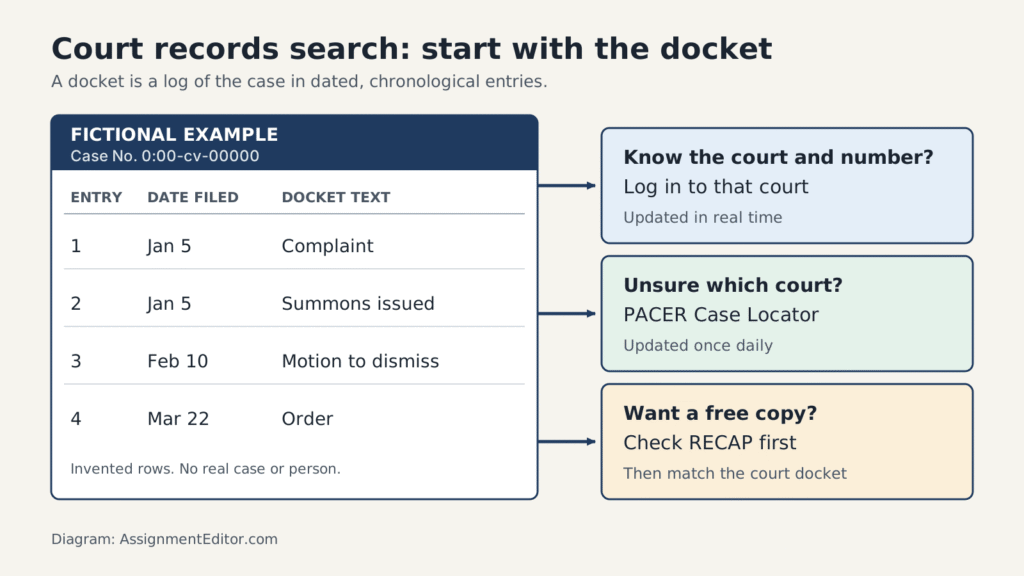
The federal courts say the main record they create is a case file that “contains a docket sheet and all documents filed in a case.” The federal courts’ glossary defines a docket as “a log containing the complete history of each case in the form of brief chronological entries summarizing the court proceedings.”
You get the same access as the public. The federal judiciary’s Journalist’s Guide says: “Journalists have the same access to courthouses and court records as other members of the public.” The guide adds that access is governed by federal laws, judicial policy and local court rules. The fee section below shows what that means for a PACER bill.
Three kinds of record need three different routes:
- Federal district, appellate and bankruptcy cases: PACER, the courts’ own system.
- Supreme Court cases: the Court’s own docket search.
- State, county and city cases: each state’s court system, and often each county clerk.
Federal FOIA is not one of the routes. The DOJ FOIA Reference Guide says the act “does not provide access to records held by Congress, the federal courts, advisory offices of the President, state or local government agencies, or by private businesses or individuals.” Ask the clerk of the court instead, and see the FOIA and public records guide for agency records. The Crime, Courts and Law beat guide lists more court sources, such as opinions and the Tax Court.
Start here
Start with these six pages. Together they cover the PACER search routes, the fees, the fee schedule, the judiciary’s reporter guide, the free copy archive and a state-by-state court directory.
PACER: Find a Case
The judiciary’s page for the two search routes, a specific court or the nationwide index. Read it before you register.
PACER Pricing: How fees work
The current per-page charges, the quarterly waiver and the tips for limiting fees.
Electronic Public Access Fee Schedule
The Judicial Conference fee schedule, including the exemption rules. Use it when you ask a court to waive fees.
A Journalist’s Guide to the Federal Courts
The judiciary’s own guide for reporters. This page covers online access, older documents and sealed records.
RECAP and CourtListener (Free Law Project) (Nonprofit)
A browser extension and a free archive of PACER documents that other users have added. Check it before you pay.
State and Federal Court Resources (DOJ)
A Justice Department directory of court resources by state. It is a link list, and DOJ does not endorse the outside sites it links.
Which court holds the case?
Each court keeps its own case information, so the first job is to name the court.
The PACER FAQ says that if you know the district or circuit, you search that court directly. If you do not, use the PACER Case Locator. Use this table to pick a route:
| What you know | Where to look | What to know |
|---|---|---|
| Court and case number | Log in to that court through the Court CM/ECF Lookup | PACER says this route is updated in real time as records are filed |
| A party name, no court | The PACER Case Locator | A nationwide index of appellate, bankruptcy and district cases, updated once daily. PACER says it returns court locations and case numbers where a party is involved in federal litigation |
| A Supreme Court case | The Supreme Court docket search | Dockets since the 2001 Term. You can sign up for email alerts on a pending case |
| A ruling only | PACER court opinions | Free for registered users. The Government Publishing Office also posts opinions from more than 130 courts back to April 2004 |
| A case filed before 1999 | The court that heard it, then the National Archives, for example its digitized New England dockets | The judiciary says most pre-1999 cases are kept on paper only |
| A bankruptcy case, by phone | The Voice Case Information System, (866) 222-8029 | PACER says most bankruptcy courts offer limited information at no cost |
| A state, county or city case | The state’s court system or the county clerk | See the state portal section below |
The line between federal and state courts matters. USAGov says federal courts handle cases that involve federal laws, such as tax and bankruptcy. State and territory courts include juvenile, family and probate court. County and municipal courts may hear petty offenses and traffic infractions.
Case number formats differ by court. The District of New Jersey, for example, explains that a number such as 3:00-cv-5 (GEB) starts with a division digit, then the filing year, then a case type such as cv or cr, then a sequence number, then the judge’s initials. Ask the clerk if you cannot read a number.
How do you search PACER?
You register, choose a route, search by case number when you can and keep the search narrow.
- Register. PACER says there is no fee to register, but there is a fee to access records once you log in. If you give a credit card, access is prompt. If you do not, an activation code goes out by U.S. mail and PACER says to allow 7 to 10 business days. PACER also offers a free demonstration site to try the system.
- Pick the route from the table above. The Case Locator and the court-by-court search both need a login.
- Search by case number when you have one. The fee page advises that searching by case number “will go directly to the case without a charge,” and a common party name “may yield a high number of pages.”
- Open the docket report and use its filters. PACER says you may be able to switch off “Parties and Counsel” and “Terminated Parties,” and to filter entries by date range. When you check a case again, set the range from your last check to the present.
- Check RECAP for a free copy before you buy a document (see below).
- Log the docket number, entry number and the date and time you pulled it, and keep your receipts.
PACER also offers help. The PACER Service Center is open 7 a.m. to 6 p.m. Central, Monday to Friday, at (800) 676-6856. Its fee page says staff can answer questions about the best ways to search for a case for free.
What does PACER cost and what is free?
As of October 30, 2026, PACER charges $0.10 per page for most records, bills quarterly and waives the bill if you spend $30 or less in a quarter. On January 1, 2027, the per-page fee becomes $0.12 and the quarterly waiver rises to $40, according to PACER’s June 26, 2026 announcement.
The PACER fee page and the fee schedule set the charges:
| Item | Charge as of October 30, 2026 | Limit |
|---|---|---|
| A document, such as a docket, motion, order, judgment or brief | $0.10 per page | Not more than $3 per document |
| Search results | $0.10 per page | No maximum, and charged even when the search shows “no matches found” |
| Reports that are not case-specific, such as the cases report | $0.10 per page | No maximum |
| Transcripts | $0.10 per page | No maximum. Added to PACER 90 days after they are produced |
| Audio file of a hearing | $2.40 per file | Some hearings only |
Search charges catch new users. The fee page says: “Anytime a search is performed you are charged a fee based on the number of pages generated in the search, even if the search displays ‘no matches found.’”
The waiver works by quarter. The fee schedule says no fee is owed “until an account holder accrues charges of more than $30.00 in a quarterly billing cycle.” The fee page says users are billed when they accrue more than $30 in the previous quarter.
PACER lists four cases when it is free:
- You are a party in a case and receive a notice of electronic filing or notice of docket activity from a court, which includes one free copy.
- You view case information at any federal courthouse.
- You are an individual or group granted a fee exemption.
- Court opinions, which are always free.
The courthouse route has a small charge. The judiciary says you can view records at the courthouse for free, with a fee of 10 cents per page to print from a public access terminal.
Will the court waive fees for a reporter?
Do not count on it. The fee schedule says courts may exempt some groups and should not exempt others: “Examples of individuals and groups that a court should not exempt include: local, state or federal government agencies, members of the media, privately paid attorneys or others who have the ability to pay the fee.” Among the groups a court may consider are Section 501(c)(3) not-for-profit organizations and individual researchers associated with educational institutions. The schedule also says exemptions are the exception and not the rule.
The schedule does not say how a court treats a nonprofit newsroom. Ask the clerk of the court that holds your case. The judiciary says to contact a court directly if you seek a fee exemption from a single court or for non-research purposes.
What changes on January 1, 2027?
The per-page fee rises from 10 cents to 12 cents, and the automatic exemption rises from $30 to $40 a quarter.
The PACER announcement of June 26, 2026 says the increase helps reimburse the cost of building a new case management and public access system. It says the fee increase “will remain in place for a five-year period” and is the first adjustment in nearly 15 years. In 2012 the per-page fee went from 8 cents to 10 cents. The announcement does not mention the $3 per-document cap or the audio fee, so check the pricing page after January 1.
Fictional example, with arithmetic from the published rates: an 8-page docket report costs $0.80 now and $0.96 after January 1, 2027. A 45-page brief would cost $4.50 at 10 cents a page, but the fee schedule limits one document to the fee for 30 pages, so the charge is $3.00 now.
To recap: name the court, search by number, read the docket before you buy documents, check RECAP and log every pull. The next sections show how to read a docket, which free options exist and how state portals differ.
How do you read a federal docket?
Read the docket from the first entry down, and open the complaint, indictment or petition before the motions.
The docket is the index to the case. Here are the main opening documents, as the federal courts’ glossary defines them:
| Document | Federal courts’ glossary definition (condensed) | What to ask when you open it |
|---|---|---|
| Civil complaint | A written statement filed by a plaintiff initiating a case, stating the court’s jurisdiction, the wrongs allegedly committed and the requested relief | Who is suing whom, and what do they want? |
| Criminal complaint | A sworn document filed by the government, alleging a crime and probable cause to arrest an individual | What is the alleged crime, and who swore to the facts? |
| Indictment | The formal charge issued by a grand jury stating there is enough evidence of a crime to justify having a defendant stand trial | Which counts are charged? The judiciary calls an indictment “a road map to what the prosecution intends to prove at trial” |
| Information | A formal accusation by a government attorney that the defendant committed a misdemeanor. It may also be used in a felony case if the defendant waives a grand jury indictment | Did the defendant waive an indictment? |
| Arraignment | A proceeding in which a criminal defendant is told of the charges and asked to plead guilty or not guilty | What was the plea? |
The glossary entries are for the civil complaint and criminal complaint, the indictment, the information and the arraignment. The judiciary’s guide to reporting on criminal cases adds that courthouse beat reporters may find it useful to review unsealed warrants regularly, and says a supporting affidavit “offers a detailed account of the allegations.” The guide on covering civil cases says a civil case begins when a plaintiff files a complaint.
Example: a public docket, Supreme Court No. 23-124
The Supreme Court’s docket for No. 23-124 is a public record of the Purdue Pharma bankruptcy plan case. The Court says its docket numbers use the format “Term year-number,” and No. 23-124 follows that format. Five entries tell the story:
| Date | Docket entry, as worded | What it tells you |
|---|---|---|
| Jul 28 2023 | “Petition for a writ of certiorari filed.” | The case reached the Court. An application for a stay (23A87) was filed the same day |
| Aug 10 2023 | “Petition GRANTED.” | The Court took the case and set a question for briefing |
| Aug 10 2023 | The order says the Second Circuit mandate in No. 22-110 “is recalled and stayed” | The appeals court’s mandate was recalled and stayed |
| Dec 4 2023 | “Argued.” | Counsel appeared for petitioner and respondents |
| Jun 27 2024 | “Judgment REVERSED and case REMANDED.” | The Court ruled, with a dissent filed |
The question the Court set for argument is on the same docket: “Whether the Bankruptcy Code authorizes a court to approve, as part of a plan of reorganization under Chapter 11 of the Bankruptcy Code, a release that extinguishes claims held by nondebtors against nondebtor third parties, without the claimants’ consent.” Use the docket’s own wording in your copy, and read the filings behind each entry.
A log line you can copy (template, not a real entry): Court | Case number | Entry number | Date filed | Date and time pulled | Where you got it (PACER, RECAP, clerk) | Cost.
What are the free alternatives to PACER?
You can read court records for free at the courthouse, in opinion databases, in court-run pages and in the RECAP archive.
| Option | What you get | Limit |
|---|---|---|
| Courthouse public terminals | Free viewing of electronic case files at the clerk’s office | 10 cents per page to print. You must go in person |
| Free opinions | PACER opinions are free, and GPO text-searchable opinions come from more than 130 courts | Opinions only, not other filings |
| Court “Cases of Interest” pages | For high-interest cases, some courts post docket entries, orders and sometimes exhibits | Only some courts, and only chosen cases |
| Court RSS feeds | Some courts offer free automatic case notification | The Journalist’s Guide says only “some courts” do |
| RECAP and CourtListener | Free copies of documents other users have added, plus docket alerts and search alerts | Coverage depends on what users have uploaded |
| Supreme Court docket | Free docket search and email alerts | Supreme Court cases only |
| National Archives | Digitized name indexes and dockets from older cases | The Boston indexes cover district courts in Connecticut, Maine, Massachusetts, New Hampshire, Rhode Island and Vermont |
The Journalist’s Guide describes the “Cases of Interest” pages, RSS feeds and read-only CM/ECF access under “Online Access.”
Free Law Project, the nonprofit behind RECAP, says that once its browser extension is installed, “your PACER purchases will be automatically added to the RECAP Archive” and “Anything somebody else has added to the archive will be available to you for free” inside PACER. Its RECAP FAQ says documents that display a restriction warning are detected and not uploaded. The FAQ also says: “On occasion, documents are not sealed in PACER even though they should be.” Such documents can be uploaded by mistake, and Free Law Project says it then works with courts, parties and users to clean things up. Treat a RECAP copy as a lead. Match the entry number and date to the court’s own docket before you quote it. The CourtListener home page describes the site as a free legal research website containing millions of legal opinions from federal and state courts.
What do state and local court portals offer?
State portals differ on which courts they cover, which case types appear online and whether documents are free.
The Texas State Law Library puts the problem plainly: “Texas doesn’t have a single database where you can search all court records for the state. Each court is responsible for keeping their own records.” Start with the state judiciary or the county clerk. The DOJ directory and USAGov point to state court sites, and USAGov says you may find a county or municipal court through your state court website. These four examples show how much portals differ:
| State | Official page | What the court’s own page says | What to check |
|---|---|---|---|
| California | Judicial Branch guidance | In sensitive cases such as divorce, child custody, civil harassment and criminal, courts “may only make available on the internet the registers of action, calendars, and case indexes.” The public may view other records at the courthouse | Rule 2.503 of the California Rules of Court lists the case types. A judge may allow remote access in an unusually high-interest criminal case, but the page says this is not typical |
| New York | e-Courts | The page lists WebCivil Local, WebCivil Supreme, WebCriminal and WebFamily case search, plus eTrack alerts for local civil, civil supreme and criminal cases | Read each search tool’s help page for the courts and case types it covers |
| Pennsylvania | Judiciary Web Portal | Public docket sheets for appellate courts, common pleas courts and magisterial district courts. A free app, PAeDocket, searches by case number, participant name and other fields. Secure docket sheets need approved access | Some services are restricted and not for public use |
| Texas | re:SearchTX | The portal’s home page advertises case information from all 254 counties. The State Law Library says its free plan covers civil cases from district, county and probate courts, “may not have all records from all counties,” and says access to full documents and other features may be available for a fee | Ask the district or county clerk for anything not online |
Use these rules for any state:
- Search the state portal first, then the county clerk’s site. Texas shows why. The library lists district clerks and county clerks as separate record holders.
- Expect limits on some case types online. California’s page says courts may show only registers of action, calendars and case indexes for criminal, divorce and custody cases.
- Ask the clerk what is public, what is sealed and how to pay for copies. Rules vary, so check your state’s law.
- Use the Regional hub for the step of finding which office holds a record, and the Local News Resources guide to map the county.
How do you find bankruptcy records?
Search bankruptcy cases in PACER or by phone, and read the docket for the chapter, the trustee and the first-day orders.
Federal bankruptcy courts are part of the district court system. The Journalist’s Guide says there are 90 U.S. bankruptcy courts, which “by statute, are units of the U.S. district courts.” Their records are public. The statute, 11 U.S.C. 107(a), says “a paper filed in a case under this title and the dockets of a bankruptcy court are public records and open to examination by an entity at reasonable times without charge,” except as subsections (b) and (c) provide. Those subsections let the court protect trade secrets and confidential commercial information, scandalous or defamatory matter, and information that would create an undue risk of identity theft or other unlawful injury.
Online, the judiciary says bankruptcy documents can be viewed through PACER or at the bankruptcy clerk’s office. By phone, the judiciary says all bankruptcy courts have a telephone information system, the Voice Case Information System, that gives basic case information free, 24 hours a day.
| Chapter | The judiciary’s description | Reporter use |
|---|---|---|
| Chapter 7 | Non-exempt assets are liquidated and proceeds go to creditors | Find the trustee on the docket. Most cases are “no assets” cases |
| Chapter 9 | Covers local governments and instrumentalities | Check for a city, county or district debtor |
| Chapter 11 | Allows businesses to reorganize and continue operating | Look for first-day orders, the plan and the confirmation hearing |
| Chapter 12 | Covers family farmers and fishermen | Farm and fishing debtors |
| Chapter 13 | Debtors with regular income keep assets and obtain court-confirmed plans to pay creditors | Mostly individual debtors, so weigh privacy before you name anyone |
| Chapter 15 | Applies to foreign corporations and individuals | Look for a foreign proceeding |
Three facts help on deadline. First, the judiciary says more than 95 percent of bankruptcy cases are filed by consumers, so a name search often returns private individuals. Use the Editorial Standards before you name one. Second, a meeting of creditors is held in every case, and the case trustee presides, not a judge. Third, the judiciary says its policy “does not grant journalists access” to the telephone and video conferences that are common in bankruptcy proceedings.
For a worked example of a Chapter 11 plan dispute, read the public Supreme Court docket No. 23-124 in the section above.
What can’t you see?
You cannot see sealed filings, redacted details, most discovery that was never filed and records a state makes courthouse-only.
- Redactions. The Journalist’s Guide says federal rules require filers to redact Social Security or taxpayer identification numbers, dates of birth, names of minor children and financial account information, and in criminal cases, home addresses.
- Documents not ordinarily public. The guide lists unexecuted summonses or warrants, pretrial bail and presentence reports, juvenile records and documents containing information about jurors.
- Sealed filings and closed hearings. Judges can seal more documents. Generally, when a party moves to seal a document or close a hearing, the judiciary says “a record of the motion can be found in PACER,” and media organizations sometimes oppose these requests. The Federal Judicial Center’s sealing pocket guide says court case records and proceedings “are presumptively public, but occasionally there are compelling reasons for keeping all or parts of them confidential”.
- Discovery. The guide says the media “do not have a right of access to discovery materials not filed with the court,” and settlement terms may stay confidential.
- Grand juries. By rule, only a witness, attorneys for the government and a court reporter may be present when a grand jury sits.
- Courthouse-only state records. See California above.
On dockets as a legal matter, the Reporters Committee for Freedom of the Press (Advocacy) reports in its Open Courts Compendium that the Supreme Court “has declined to address whether the constitutional presumption of access applies to civil or criminal court dockets.” RCFP adds that federal appellate courts have recognized the right, and quotes the Second Circuit in Hartford Courant Co. v. Pellegrino, 380 F.3d 83 (2d Cir. 2004): “the press and public possess a qualified First Amendment right of access to docket sheets.” The rule can differ by circuit and state, so check your state’s law and ask your editor or counsel before you challenge a seal.
Reporting checks
- Write down the court, case number, entry number, filing date and the date and time you pulled the record.
- Read the docket entry or the filing itself. Do not rely on a news summary or a third-party site.
- Confirm the court is the one you think it is, federal or state, and the case type.
- Treat a complaint, criminal complaint or indictment as an allegation. Report what a court has decided only from an order or judgment.
- Match a party name to your subject with a second identifier before you publish. A name search can return many cases.
- Compare any RECAP or CourtListener copy with the court’s docket.
- Look for a motion to seal or a sealed-entry notation. Ask the clerk whether more is public.
- Call the clerk’s office with questions. The judiciary says the clerk’s office is usually a court’s designated point of contact with the media.
- Weigh privacy before you name private individuals, using the Editorial Standards.
- Give the people named in the record a real chance to respond.
- Ask a lawyer or subject expert to read technical filings, and vet that person through Find Experts and Sources.
- Save the receipts and your log with the documents, and track your quarterly PACER total against the waiver.
Next step: Crime, Courts and Law Beat Guide
Sources
- PACER: Find a Case
- PACER Pricing: How fees work
- PACER: Temporary Fee Increase Effective Jan. 1, 2027
- PACER: Search by Specific Court
- PACER: Search by National Index
- PACER: Court CM/ECF Lookup
- PACER: Court Opinions
- PACER: Case Search Only registration
- U.S. Courts: Electronic Public Access Fee Schedule
- U.S. Courts: Court Records
- U.S. Courts: Find a Case (PACER)
- U.S. Courts: Glossary, docket
- U.S. Courts: Glossary, complaint
- U.S. Courts: Glossary, indictment
- U.S. Courts: Glossary, information
- U.S. Courts: Glossary, arraignment
- Journalist’s Guide: Federal Court Media Basics
- Journalist’s Guide: Accessing Court Documents
- Journalist’s Guide: Reporting on Criminal Cases
- Journalist’s Guide: Covering Civil Cases
- Journalist’s Guide: Bankruptcy Courts and Cases
- U.S. Supreme Court: Docket Search
- U.S. Supreme Court: Docket for No. 23-124
- DOJ Office of Information Policy: FOIA Reference Guide
- DOJ Justice Management Division: State and Federal Court Resources
- USAGov: Federal, state, territory, county, and municipal courts
- National Archives at Boston: Digitized U.S. District Court Name Indexes and Dockets
- Federal Judicial Center: Sealing Court Records and Proceedings, A Pocket Guide
- District of New Jersey: case number format
- Cornell LII: 11 U.S.C. 107, Public access to papers
- Free Law Project: RECAP
- Free Law Project: RECAP FAQ
- CourtListener
- Judicial Branch of California: Viewing a Court’s Electronic Case Records
- New York Courts: e-Courts
- Pennsylvania Judiciary Web Portal
- re:SearchTX
- Texas State Law Library: Court Records
- Reporters Committee for Freedom of the Press: Open Courts Compendium, Dockets (Advocacy)
Sources
- PACERpacer.uscourts.gov
- the main record they create is a case fileuscourts.gov
- DOJ FOIA Reference Guidejustice.gov
- RECAP and CourtListener (Free Law Project)free.law
- Supreme Court docket searchsupremecourt.gov
- digitized New England docketsarchives.gov
- USAGovusa.gov
- 3:00-cv-5 (GEB)njd.uscourts.gov