Property records for reporters: find the owner, the deed and the debts
How to look up who owns a parcel, read the deed and tax record, check for liens and use parcel maps. County portals appear as examples only. Each link was checked in October 2026.
On this page
- What do property records cover?
- Start here: six primary sources
- Who owns this property? Seven steps
- Which county office holds which record?
- How do you search the recorder’s index?
- What does a deed tell you, and what does it not?
- How do assessor and property tax records work?
- What do parcel maps and GIS viewers show?
- How do you find liens, mortgages and pending suits?
- How do you look behind an LLC?
- When should you use bulk data or open data?
- What limits and privacy rules apply?
- Reporting checks
- Sources
What do property records cover?
Property records are county files on a parcel: its owner of record, its transfers, its assessed value, the taxes owed and the claims against it.
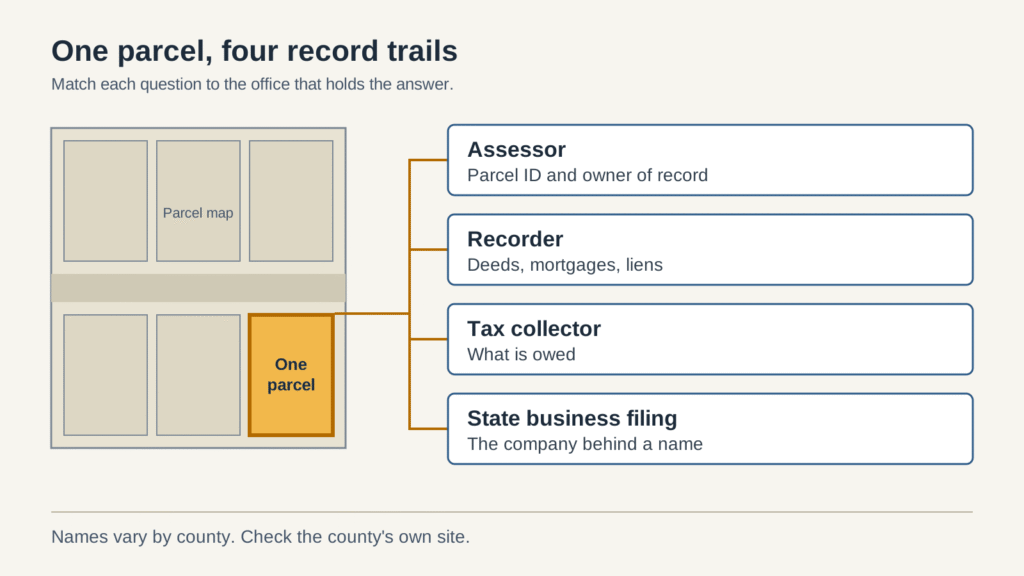
The UNT guide says these records “can often be researched at the website of the county where the property is located.” Different offices hold different pieces. The table shows the usual split. Office names vary, so confirm them on the county’s own site.
| Your question | Usual office | Record to open | What the record does not prove |
|---|---|---|---|
| Who is the owner of record, and what is the parcel ID? | Assessor, property appraiser or appraisal district | Assessment roll or parcel record | A sale that has not been processed yet, or who controls the property |
| How did title change hands? | Recorder, register of deeds, registry of deeds or clerk | Deed, mortgage, release, plat | Good title or the true sale price |
| What is owed? | Treasurer, tax collector or tax commissioner | Tax bill, delinquency record, lien sale list | Debts that are not tax debts |
| Where is the parcel? | Assessor map or county GIS viewer | Parcel map | A survey boundary |
| Who is behind a company name? | Secretary of state or equivalent | State business filing | The person who benefits from the company |
A recorder’s index is not a title search. Cornell’s Legal Information Institute defines a title search as “a search of the public records for any defects or encumbrances in a property’s chain of title.” A reporter’s lookup finds documents. It does not certify ownership.
This guide does not cover vital records, court dockets or people-search sites. Use the Obituaries and Death Records guide for death records and the Crime, Courts and Law guide for court sources.
The County Records and Local News Research guide explains how to find which county office holds which record. This page starts after that step.
Start here: six primary sources
Use these six pages to find the county, name the parcel, trace a company and check federal liens and land records.
USAGov: Local governments
Finds a local town, county or city government’s website. Use it to reach the county’s own site.
Census Geocoder
Matches a U.S. address to the geographic entities that contain it. Use it to confirm the county before you search.
NASS: Corporate Registration
Opens each state’s business registration pages and corporate name databases. Use it when a deed names a company.
IRS: Understanding a federal tax lien
The IRS explains what a federal tax lien is and what a Notice of Federal Tax Lien does.
BLM General Land Office Records
Federal land title records for the Public Land States. Use it for the first transfer of land out of federal hands.
Massachusetts Land Records
A statewide portal to registries of deeds. It is one example of a state that puts many counties on one site.
Who owns this property? Seven steps
Find the parcel ID in the assessor’s record, then read the latest recorded deed to confirm who holds title.
You can run this check in seven steps. Counties differ, so treat each step as a pattern and check your county’s own site.
- Get the street address and confirm the county. The Census Geocoder “only geocodes addresses that are within the United States, Puerto Rico, and the U.S. Island Areas.” Then reach the county’s site through the USAGov local governments directory.
- Find the parcel ID in the assessor’s search. Cook County, Illinois lets you search by Property Index Number (PIN) or by address. Denver accepts an address, Parcel ID or schedule number. San Diego County calls it the Assessor’s Parcel Number (APN).
- Read the owner of record and the record date. San Diego County’s Assessor says property ownership and address information are provided over the phone. Assessor data can lag a sale. Cook County’s open data notes that sales are reported on a lag, with many records not appearing until months after the recording date.
- Search the recorder’s index by parcel, address and name. Massachusetts registries “create a searchable index with property addresses and the names of all parties to each document”. Search every name variation.
- Pull the latest deed and read it. Note the grantor, the grantee, the legal description, the date and the stated consideration. The deed section below explains what each part means.
- If the buyer is a company, check the state business filing. Take the exact company name from the deed and search the secretary of state’s records through the NASS corporate registration page.
- Log the office, the date, the parcel ID and the document number. Save a screenshot or a copy of the document. A fictional log template appears under Reporting checks.
Boundary: these steps name the owner of record. They do not show who controls an LLC, whether the title is clear or whether a recent sale has reached the assessor’s file.
Which county office holds which record?
County and state offices split the work differently, so find the office on the county’s own site before you search.
The table shows six examples. It is not a survey of all states, and office names change from place to place. For the office-finding step, use the County Records and Local News Research guide.
| Example place | What the official page says | Source |
|---|---|---|
| Massachusetts | The state is divided into 21 registry districts, each with an elected Register of Deeds. Each registry records all documents about real estate ownership within its district | Massachusetts Land Records |
| Georgia | The Board of Tax Assessors handles valuation. The Tax Commissioner collects ad valorem taxes. The Department of Revenue lists links to county tax office websites | Georgia Department of Revenue |
| Texas | Appraisal districts appraise property value as of January 1 each year. In many counties, taxing units contract with the county tax assessor-collector to collect property taxes | Texas Comptroller |
| San Diego County, California | The page header reads Assessor, Recorder, County Clerk. The page covers property ownership, parcel maps and copies of recorded documents | San Diego County ARCC |
| Denver, Colorado | Denver’s Assessment and Taxation System searches assessment and tax data for real estate and business personal property | Denver Property Search |
| New York City | ACRIS searches property records and document images for Manhattan, Queens, Bronx and Brooklyn from 1966 to the present | NYC Department of Finance |
Check your county. A state portal may cover some counties and not others, and a county may split the assessor, recorder and tax collector across three websites.
How do you search the recorder’s index?
Recorders index documents by party name, and many also index by address or parcel, so search more than one way.
Sonoma County, California says “All recorded documents are indexed by the names of the principal parties.” The same page says you need “the name of at least one party and the approximate year the document was recorded.” Massachusetts registries assign each document a book and page number.
Use these search habits:
- Search every spelling variation. Sonoma County advises searching all possible spelling variations of names.
- Expect abbreviations in older entries. Before 2010, Sonoma County abbreviated words such as Bank, Company and Trustee in its grantor and grantee index.
- Search both grantor and grantee. Union County, Ohio keeps separate direct (grantor) and reverse (grantee) index books for deeds and mortgages.
- Check how far back the online index goes. Coverage differs by county, as the table shows.
| Example | Online coverage the page states |
|---|---|
| Sonoma County, California | Online index of official public records recorded from 1964 to the present. Earlier documents are indexed in handwritten volumes at the office |
| Union County, Ohio | Images and indexes online from 1995 to current. Deed indexes for 1875 to 1994 are posted as index books |
| NYC ACRIS | Property records and document images from 1966 to the present for four boroughs |
Images may not be online. Sonoma County’s page says “Recorded and filed documents and maps are public records” and that you can view them in its offices at no cost. The same page says “California law prohibits the display of recorded documents on the internet.” It lists online rates for purchased copies. Rules differ by state, so check your county.
Copies can cost money. San Diego County’s page says copies of any property record are $2 for the first page of a document and $0.05 for each additional page. That is the rate on the page on October 30, 2026.
An index entry is a pointer. Sonoma County says “the index is similar to a library card catalogue” and “should not be relied upon in making any decision or determination regarding the underlying document.” Open the document.
What does a deed tell you, and what does it not?
A deed names the grantor and the grantee, describes the land and states consideration, but it does not prove the title is good.
Cornell’s Legal Information Institute says a deed “is usually recorded in the local county clerk’s office.” It lists the elements a valid real estate deed generally needs: the names of the grantor and grantee with words of conveyance, a legal description, a statement of consideration, and a signature by the grantor with delivery to the grantee. The same page says different jurisdictions require different elements.
Read these parts in order:
- Grantor and grantee. The grantor transfers. The grantee receives.
- Legal description. It identifies the land. Compare it with the parcel ID and the address.
- Date and recording information. Note the date on the deed and the date recorded. They can differ.
- Deed type. The LII deed page names three: a warranty deed, a special warranty deed and a quitclaim deed. LII says a quitclaim deed “makes no warranties that the property has clean title.”
- Consideration. Read the next paragraph before you use it.
The stated consideration is not always the sale price. LII says “The amount of consideration does not matter” and gives the example “for Twelve Dollars and other good and valuable consideration.” Cook County’s open data file of parcel sales shows the effect. The platform’s own summary of the sale price column lists $1 as its most frequent value, in 166,209 of 2,688,811 rows at the time of this check. The summary does not say why. The Assessor’s description says the file “likely include[s] non-arms-length transactions.”
Some states collect the price on a separate form. In Illinois, a filer must submit Form PTAX-203 with the deed at the County Recorder’s office unless an exemption applies, and line 11 asks for the “full actual consideration (sale price).” Check your state and county for the equivalent, and ask the office whether the form is public.
Mortgages and deeds of trust secure loans. LII says a deed of trust is a type of secured real estate transaction “that some states use instead of mortgages.” It involves a lender, a borrower and a trustee. Look for both in the index. Union County, Ohio lists mortgages in separate index books.
To recap the method: name the parcel at the assessor, read the latest deed at the recorder, treat the stated price as a clue and not a fact, and check for liens before you write that someone owns a property free and clear. The sections below cover tax records, maps, liens and companies.
How do assessor and property tax records work?
An assessor sets a value for taxation. That value is not the sale price, and the taxable value may differ again.
Cook County’s Assessor explains the steps. Its residential valuation page says that for residential properties, a property’s “assessed value equals 10% of its fair market value, per Cook County ordinance.” Its assessment notice and tax bill page says a state equalizer is then applied to create the Equalized Assessed Value, and exemptions are subtracted from that figure. Levels of assessment differ by state and county, so check your county’s own rule.
Texas works differently. The Texas Comptroller says appraisal districts appraise your property’s value as of January 1 each year. The page adds that market conditions and who owns the property on that date determine whether the property is taxable, the value at which it can be taxed and who is responsible for paying the tax. The Comptroller also says more than 4,796 local taxing units in Texas assess property tax. Those units include school districts, cities, counties and special districts.
Valuation and collection can sit in different offices. The Georgia Department of Revenue says the Board of Tax Assessors handles valuation of real and personal property and the Tax Commissioner collects ad valorem taxes.
Many counties publish tax data online. Denver’s page says you can search assessment and tax data by address, Parcel ID or schedule number and that the information is updated daily. During October or November, the page says the annual tax lien sale is conducted, and additional fees and amounts may not appear online. Call the office for the exact amount.
Constraints: a tax record shows a value, an owner of record and an amount due. It does not show the price the owner paid. Cook County’s own page says it cannot guarantee against errors made in posting data. Confirm any number you publish with the office.
What do parcel maps and GIS viewers show?
A parcel map shows how the assessor divides land for taxation. It is not a survey and does not settle a boundary.
San Diego County says an Assessor’s parcel is “an area of land delineated on a map by the County for the sole purpose of collecting taxes on property.” The page adds that the map shows the APN, which “can be used to obtain ownership and address information.”
Two other counties state the limit in plain terms:
- Dane County, Wisconsin says its parcel maps are for tax and real property listing purposes only and “do NOT represent a survey.” It advises using the original recorded documents for legal or survey information.
- Sacramento County, California says parcel maps are for assessment purposes only and that parcel lines “may not accurately reflect legal descriptions.”
Use a parcel viewer to find the parcel ID, neighboring parcels and the mapped shape. Then use the recorded deed and any recorded plat or survey for the legal description. In New York City, ACRIS lets you find a property’s borough-block-lot (BBL) number or address. Other places use other numbering systems.
How do you find liens, mortgages and pending suits?
Liens and pending suits appear as recorded notices or in court files, so search the recorder’s index and then the court record.
The table shows four claim types and where each source says they appear. Practice varies by state, so check your state’s law and your county’s index.
| Claim | What it is | Where it appears | Source |
|---|---|---|---|
| Federal tax lien | The IRS files a public Notice of Federal Tax Lien to alert creditors that the government has a legal right to your property | For real property, in one office designated by state law in the county where the property sits | IRS, 26 U.S.C. 6323(f) |
| Mechanic’s lien | A statutory security interest that secures payment for labor, materials or services used to improve, repair or maintain property | Under state law. Look in the recorder’s index and in state lien rules | LII |
| Lis pendens notice | A notice recorded in a property’s chain of title that warns of pending litigation affecting the title | Recorded in the chain of title | LII |
| Property tax lien sale | An annual county sale tied to unpaid taxes. Denver says its sale is conducted in October or November | County treasury office | Denver |
On federal liens, 26 U.S.C. 6323(f)(1)(A)(i) says the notice is filed “in one office within the State (or the county, or other governmental subdivision), as designated by the laws of such State, in which the property subject to the lien is situated.” That is the office to ask about. The IRS page says it releases a lien within 30 days after full payment. A withdrawal removes the public notice, but the person is still liable for the amount due. Look for a release or a withdrawal, not only the filing.
A lis pendens warns that a suit is pending. LII says it warns “all persons that any interests acquired during the pendency of the suit are subject to its outcome.” The suit itself sits in a court file. The Crime, Courts and Law guide lists court sources.
Constraint: a clean index search does not prove a property is free of claims. Some claims are not recorded with the county. Ask the office what its index covers.
How do you look behind an LLC?
A deed that names a company points you to a state business filing, which is a different record from the property record.
The National Association of Secretaries of State says most of its member offices handle the registration of domestic and foreign corporations. Use its page to open the state’s business search. Copy the exact company name from the deed. Read what the filing lists and note the filing date. The Business guide covers company records in more depth.
Check this assumption before you rely on it: that a federal database will name the people behind a U.S. company.
- Why the assumption persists. FinCEN collected beneficial ownership reports under the Corporate Transparency Act until it published an interim final rule on March 26, 2025 that removed the requirement for U.S. companies.
- Correction. FinCEN’s page, updated August 11, 2026, says “U.S. companies are exempt from the Beneficial Ownership Information (BOI) reporting requirements and therefore, are no longer required to file BOI reports.” The page says the final rule made the exemptions from the March 2025 interim rule permanent and became effective on August 14, 2026. It says that interim rule limited “reporting company” to entities formed under foreign law that registered to do business in a U.S. state.
- What to do. Work from the deed, the mortgage, the state filing and your own reporting. File a records request for documents the agency holds. The FOIA and Public Records Requests guide explains the process.
Constraint: this guide covers records, not intent. A company name on a deed does not tell you whether the buyer is a developer, a lender or a family. Say what the record shows and no more.
When should you use bulk data or open data?
Open data lets you analyze many parcels at once, but each publisher filters, delays and formats its files in its own way.
Cook County, Illinois publishes a parcel sales file for 1999 to present. Its description sets out the limits. The file is “filtered, but likely include[s] non-arms-length transactions.” It says sales under $10,000, quit claims, executor deeds and beneficial interests are excluded, and sales are reported on a lag. The dataset’s metadata also lists indicator columns for sales under $10,000 and for quit claim, executor, beneficiary and missing deed types. Read the column list before you filter.
Two practical rules from the same description:
- Zero-pad PINs to 14 digits. The Assessor says some datasets lose leading zeros when downloaded, which can break joins with other files.
- Use the sale document number. It corresponds to the Cook County Clerk’s number and can be used on the Clerk’s website to find more about each sale.
Do not scrape portals that limit traffic. NYC’s Department of Finance says daily bandwidth utilization is restricted to 400 MB, and that high-volume users should contact the City Register’s Office about data subscription services. Ask the office for a bulk export first.
For federal land, the BLM says its General Land Office Records site gives online access to images of more than five million federal land title records. The page also says the site does not contain every federal title record issued and points you to your state or local office for more.
What limits and privacy rules apply?
Some addresses are protected by law, some records cost money and some websites only look official, so check each before you publish.
New Jersey’s Daniel’s Law is one example of a restriction. The state’s redactor site says the law amended the Open Public Records Act to expand protections from public exposure for personal information about active and retired judges, law enforcement officers and prosecutors, and their immediate family members. Other states have their own rules. Check your state’s law and ask the county before you publish a home address.
Be careful with lookalike sites. NYC’s Department of Finance says neither ACRISasap nor ACRIS.com is an approved service. A private site that sells records is not the record. Get the document from the office that holds it. For people lookups, see the White Pages guide.
If the record is not online, ask the office how to get it. If the office refuses, use your state’s public records law. The FOIA and Public Records Requests guide explains which law covers state and local records and how to file.
Weigh privacy before you name a private owner. The Editorial Standards page sets the site’s expectations. This guide is a research aid, not legal advice.
Reporting checks
- Confirm the county with the Census Geocoder before you search.
- Record the parcel ID exactly as the assessor prints it.
- Compare the legal description in the deed with the assessor’s parcel record.
- Read the deed itself, not only the index entry.
- Treat stated consideration as a clue. Look for a transfer form or a sales file before you cite a price.
- Search for mortgages, liens, releases and lis pendens notices after the latest deed.
- Check the date of the latest data and note any lag in the office’s file.
- For a company, pull the state business filing and save it with the deed.
- Check your state’s rules on protected addresses before you publish a home address.
- Give the owner a real chance to respond.
- Save every document and log the office, the date and the document number.
A fictional log template follows. Every entry is invented.
| Field | Fictional example |
|---|---|
| Parcel ID | 00-00-000-000 (fictional) |
| Office and date checked | Example County Assessor, October 30, 2026 (fictional) |
| Owner of record | Example Holdings LLC (fictional) |
| Latest deed | Warranty deed, document 0000000, recorded on a fictional date |
| Consideration on deed | $10 and other consideration (fictional) |
| Mortgage or lien found | One mortgage, no release seen through the check date (fictional) |
| Entity check | State business filing pulled on the check date (fictional) |
| Second source | Interview with the owner’s representative (fictional) |
Next step: open the County Records and Local News Research guide, find the county’s assessor and recorder, and start at step 1.
Sources
- University of North Texas Libraries: Public Records, Property Records
- USAGov: Local governments
- U.S. Census Bureau: Census Geocoder
- National Association of Secretaries of State: Corporate Registration
- IRS: Understanding a federal tax lien
- Cornell Legal Information Institute: 26 U.S. Code 6323
- Bureau of Land Management: General Land Office Records
- Bureau of Land Management: Federal Land Records
- Massachusetts Secretary of the Commonwealth: Massachusetts Land Records
- Georgia Department of Revenue: Property Records Online
- Texas Comptroller of Public Accounts: Property Tax System Basics
- County of San Diego Assessor/Recorder/County Clerk: Property Information
- City and County of Denver: Property Search
- NYC Department of Finance: ACRIS
- Cook County Assessor: Assessor Property Details Search
- Cook County Assessor: How Residential Property Is Valued
- Cook County Assessor: Your Assessment Notice and Tax Bill
- Cook County Open Data: Assessor – Parcel Sales
- Cook County Open Data: Assessor – Parcel Sales, dataset metadata
- Illinois Department of Revenue: Instructions for Form PTAX-203
- Sonoma County Clerk-Recorder-Assessor: Search Our Records
- Union County, Ohio Recorder: Recorder Disclaimer and index books
- Cornell Legal Information Institute: deed
- Cornell Legal Information Institute: deed of trust
- Cornell Legal Information Institute: title search
- Cornell Legal Information Institute: mechanic’s lien
- Cornell Legal Information Institute: lis pendens
- Dane County, Wisconsin: AccessDane Disclaimer
- Sacramento County Assessor: Data Disclaimer for Assessor Parcel Viewer
- FinCEN: Beneficial Ownership Information
- State of New Jersey: Daniel’s Law for Redactors
Sources
- “typically maintained at the county level”guides.library.unt.edu
- “a search of the public records for any defects or encumbrances in a property’s chain of title.”law.cornell.edu
- USAGov: Local governmentsusa.gov
- Census Geocodergeocoding.geo.census.gov
- NASS: Corporate Registrationnass.org
- IRS: Understanding a federal tax lienirs.gov
- BLM General Land Office Recordsglorecords.blm.gov
- Massachusetts Land Recordsmasslandrecords.com