FOIA and public records requests for reporters
One workflow for federal FOIA, state open records laws and local records requests, from the first search to checking what comes back. Each link was checked in October 2026.
On this page
- What law covers the records you want?
- Start here
- How do you file a federal request in seven steps?
- How do federal agencies differ in how they take requests?
- How do state and local deadlines differ?
- How do you write the request letter?
- How do fees, news media status and expedited processing work?
- How long does an agency have to answer?
- What do you do when an agency stalls, denies or redacts?
- How do you track requests?
- How do you verify what comes back?
- Sources
What law covers the records you want?
Federal FOIA covers executive-branch agency records and does not reach Congress, federal courts, or state and local agencies.
The DOJ FOIA Reference Guide says the act “does not provide access to records held by Congress, the federal courts, advisory offices of the President, state or local government agencies, or by private businesses or individuals.” The same guide says all states have their own statutes on access to state and local records.
FOIA.gov says about 100 agencies are subject to the FOIA, with several hundred offices that process requests. No central office handles requests for all of them. Generally any person, citizen or not, can make a federal request.
Use this rule to pick the law:
- Federal agency or component: cite the Freedom of Information Act, 5 U.S.C. 552.
- State agency, county, city, school district or other local body: cite your state’s statute by name and section.
- Congress, federal courts, private companies: federal FOIA does not apply, so look for other routes.
Each state names its law differently. Illinois calls it the Freedom of Information Act, codified at 5 ILCS 140. The Texas Attorney General calls Texas’s law the Public Information Act. Florida’s public records law is Chapter 119 of the Florida Statutes. The Reporters Committee for Freedom of the Press (RCFP) (Advocacy) uses the abbreviation CPRA for the California Public Records Act.
Common mix-up: reporters often say “FOIA request” for any records request. Federal FOIA does not cover city or state offices, so cite your state’s law in those requests. The Beats hub covers the habit briefly, and the Local News Resources guide shows how to map the record holder.
Start here
FOIA.gov: How do I make a FOIA request?
The government’s central FOIA site explains the writing rule, the lack of a required form and the search-first step.
FOIA.gov: Identify an agency to request from
The government’s list of federal agencies, with contact information for each agency’s FOIA office.
5 U.S.C. 552 on FOIA.gov
The statute text. Use it for deadlines, fee categories, expedited processing, exemptions and appeal rights.
DOJ FOIA Reference Guide
The Department of Justice Office of Information Policy explains how to request from DOJ. It also states the scope of the act.
OGIS: Request OGIS Assistance
The National Archives’ FOIA ombuds office explains what it does, what it does not do and what to send.
Open Government Guide (Advocacy)
RCFP’s state-by-state guide covers all 50 states and the District of Columbia, per its introduction.
How do you file a federal request in seven steps?
You can file a federal FOIA request in seven steps, and none needs a special form.
FOIA.gov says, “The request simply must be in writing and reasonably describe the records you seek.” The same page says there is no specific form that must be used.
- Search for the records first. Check the agency website, its FOIA library and the FOIA.gov search tool. FOIA.gov advises: “Before making a request, first look to see if the information you are interested in is already publicly available.”
- Find the right FOIA office. Use the FOIA.gov agency search, then send the request to the FOIA office of the agency or component you believe holds the records, as the FOIA.gov FAQ advises.
- Describe records, not questions. Name the records, the subject and the date range. The FOIA.gov how-to says agencies do not have to “create new records or to conduct research, analyze data, or answer questions.”
- State your fee category and fee limit. Say you are a representative of the news media only if you meet the statute’s definition, and state the most you will pay.
- Send it the way the agency accepts. Use the web form, email or mail as the agency’s FOIA page directs, and keep proof of what you sent.
- Record the tracking number. The statute requires a tracking number for requests that will take longer than ten days, per 5 U.S.C. 552(a)(7).
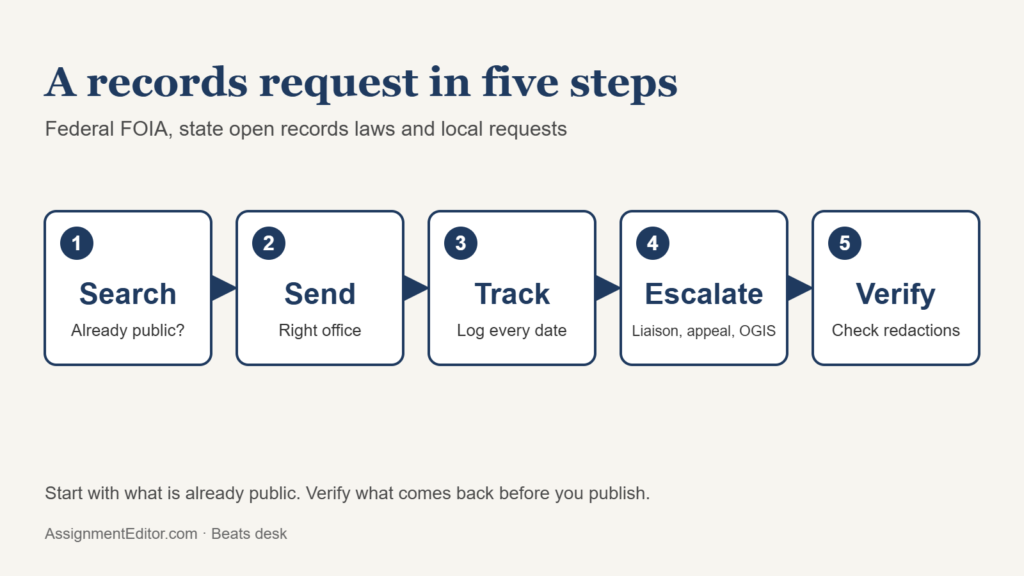
- Follow up, then escalate. Ask about status when the deadline passes. Then use the FOIA Public Liaison, an appeal, OGIS and court as needed.
Boundary: these steps cover federal agencies. For state and local offices, replace steps 2 to 4 with your state’s rules and use the state section below.
How do federal agencies differ in how they take requests?
Federal agencies share one statute but publish different rules for submission and fees, so read the agency’s FOIA page before you file.
The statute requires each agency to publish regulations that set its fee schedule, under 5 U.S.C. 552(a)(4)(A)(i). A request must also follow the agency’s published rules on time, place, fees and procedures, under 5 U.S.C. 552(a)(3)(A). The table shows four agencies as examples, not a survey of all agencies.
| Agency | How its page says to submit | Fee detail on its page |
|---|---|---|
| DOJ | In writing. Many components accept web form, email or fax. Start with “Freedom of Information Act Request” | Five cents per page for duplication. No fee if the total stays at or below a minimum, currently $25 |
| DHS | “You must submit your request online in most cases,” to the DHS Privacy Office or a component | Not stated on the steps page |
| USCIS | Online is fastest. Its page says requests by mail, fax or email cause delays, but it still lists all three | Not stated on this page |
| HHS OIG | No email. Use its online portal or FOIA.gov. Mail or fax if you cannot file online | $0.10 per page for reproduction |
DOJ’s rate is the figure in its reference guide on October 30, 2026, and the guide uses the word “currently.” The HHS OIG rate is the figure on its FOIA page on the same date. Neither rate applies to other agencies.
Expedited processing varies too. FOIA.gov says two situations apply to every agency and agencies may add standards in their FOIA regulations. DOJ lists four standards, and one is “widespread and exceptional media interest” where questions about government integrity affect public confidence.
How do state and local deadlines differ?
State response times differ by law, so cite your state’s statute instead of the federal 20-day rule.
The table lists four states as examples and the federal rule for contrast. Statute text was checked on October 30, 2026. Check your state’s law before you rely on any row.
| Law | Stated response rule | Extension | Source |
|---|---|---|---|
| Federal FOIA | Decide within 20 days, excluding weekends and legal public holidays | Up to ten working days by written notice for unusual circumstances | 5 U.S.C. 552 |
| California Public Records Act | Determine within 10 days whether the request seeks disclosable records and notify the requester | Written notice, no more than 14 days, in unusual circumstances | Gov. Code 7922.535 |
| Illinois Freedom of Information Act | Comply with or deny within 5 business days after receipt | Not more than 5 business days for listed reasons | 5 ILCS 140/3 |
| Florida Chapter 119 | A custodian must “acknowledge requests to inspect or copy records promptly and respond to such requests in good faith.” That provision states no number of days | Not stated in that provision | Fla. Stat. 119.07(1)(c) |
| Texas Public Information Act | Produce public information “promptly.” If the officer cannot produce it within 10 business days, the officer must certify that in writing and set a date and hour when it will be available | Not stated in that subsection | Tex. Gov’t Code 552.221 |
Illinois adds a rule for silence. 5 ILCS 140/3(d) says, “Failure to comply with a written request, extend the time for response, or deny a request within 5 business days after its receipt shall be considered a denial of the request.” Illinois also has an email rule. Under 5 ILCS 140/3(c), an electronic request must appear in its entirety within the body of the email, and a public body need not open attachments or hyperlinks.
RCFP (Advocacy) chapters carry a “Last updated” date. The four chapters used here are California (January 2023), Florida (July 2021), Illinois (August 2021) and Texas (January 2025). The Texas row comes from Government Code section 552.221, checked on October 30, 2026. Confirm any deadline in the current statute.
Where to find your state’s rules
Every RCFP state section follows one standard outline, with some changes in particular states, per the guide’s introduction. The Illinois chapter uses the headings below, mostly under part IV, “Procedure for obtaining records.” Look for the same headings in your state’s chapter.
| Your question | Heading to open |
|---|---|
| Who may request, and is a reason required? | I.A, “Who can request records?” |
| Who gets my request, and what must it contain? | IV.A, “How to start” |
| How long will they take? | IV.B, “How long to wait” |
| Is silence a denial? | IV.B.3, “Is delay recognized as a denial for appeal purposes?” |
| How do I appeal? | IV.C, “Administrative appeal” |
| Is there an ombudsman or attorney general route? | IV.D, “Additional dispute resolution procedures” |
| How long do I have to sue? | IV.E.6, “Time limit for filing suit” |
County, city and school district records
Local bodies fall under the state law, because the DOJ guide says states have statutes governing state and local records. USAGov lists local government contact information by state. Send the request to the records officer or clerk, and cite the state statute. Some localities add rules. The RCFP California chapter notes that local sunshine ordinances often name an officer to field complaints.
For help in your state, use these (Advocacy) resources:
- NFOIC FOI hotlines: NFOIC compiles hotline numbers, though not every state has one.
- NFOIC state law resources: NFOIC says its state coalitions and other groups can help with request letters, records audits and training.
- RCFP Legal Hotline: open to journalists and media lawyers, informational only, and it creates no attorney-client relationship.
How do you write the request letter?
A request letter names the records, the office and the date range, and it states your fee category and fee limit.
Use the elements below. The first column is the part of the letter. The last column shows where the rule comes from.
| Element | What to write | Basis |
|---|---|---|
| Label | “Freedom of Information Act Request” as the first line | DOJ asks for this notation. Other agencies publish their own rules |
| Office | The FOIA office of the agency or component that holds the records | FOIA.gov FAQ |
| Law | 5 U.S.C. 552 for federal agencies. Your state’s statute for state and local offices | DOJ guide |
| Records | Type, subject, date range. Add date, title or name, author, recipient and subject matter if you know them | DHS steps |
| Format | The format you want, such as a searchable PDF or spreadsheet | The statute says an agency shall provide a record in the requested format if it is readily reproducible, under 5 U.S.C. 552(a)(3)(B) |
| Fee category | A statement of how you meet the news media definition, with your outlet | 5 U.S.C. 552(a)(4)(A)(ii) |
| Fee limit | A statement limiting the amount you are willing to pay | FOIA.gov FAQ |
| Contact | Your name and contact information, such as an email address | DHS steps |
Add a fee waiver or expedited processing request only when you can meet the standard. The fees section below explains both. Boundary: the table fits federal and state requests, but a state request must cite the state statute and follow the state office’s procedure.
Fictional example for a state or local office. The district, officer and dates below are invented. Replace every bracket.
To: Public Records Officer, Riverton County Schools [fictional]
Subject: Public records request under [name and section of your state’s law]
I request copies of contracts, invoices and payment records for school bus transportation, July 1, 2025 through June 30, 2026. Please send them as searchable PDF or spreadsheet files by email.
I am a reporter with [outlet]. Please tell me the estimated cost before you spend more than [dollar amount].
Please confirm receipt and tell me the response date that applies under [section]. If you withhold anything, please state the legal basis for each withholding.
[Name, phone, email]
The National Freedom of Information Coalition (NFOIC) (Advocacy) publishes sample request letters for 50 states. NFOIC says most states’ laws require requests in writing.
So far: a request must be in writing, describe the records and reach the right office under the right law. Federal agencies answer under 5 U.S.C. 552 and publish their own submission and fee rules. State and local offices answer under state statutes with their own clocks. The sections below cover fees and news media status, the federal clock, what to do when it runs out, how to log each date and how to check what comes back.
How do fees, news media status and expedited processing work?
Fee category, fee waiver and expedited processing are three separate tests under 5 U.S.C. 552.
Press credentials do not earn an automatic waiver. OGIS says, “Holding press credentials doesn’t mean an automatic fee waiver,” on its page for journalists. That page cites fiscal 2010 processing data, so use it for procedural advice and check every figure against the statute.
| Test | What the statute says | What to put in your letter |
|---|---|---|
| Fee category | A news media requester is “any person or entity that gathers information of potential interest to a segment of the public, uses its editorial skills to turn the raw materials into a distinct work, and distributes that work to an audience.” | Describe your outlet, your editorial work and your audience. A freelancer qualifies by demonstrating a solid basis for expecting publication through a news-media entity |
| Fee waiver | Records are free or reduced if disclosure “is likely to contribute significantly to public understanding of the operations or activities of the government” and is not primarily in your commercial interest | Explain how the records meet each factor in DOJ’s guidance, which OGIS lists. Inability to pay is not a basis |
| Expedited processing | A compelling need for a person primarily engaged in disseminating information is “urgency to inform the public concerning actual or alleged Federal Government activity” | Attach a statement certified true and correct. The agency must decide within 10 days |
The sources for the table are 5 U.S.C. 552(a)(4)(A) and 5 U.S.C. 552(a)(6)(E). OGIS lists six factors from DOJ’s fee waiver guidance, and the FOIA.gov FAQ says inability to pay is not a legal basis for a waiver.
The 10-day expedite decision is a statutory figure counted from the date of the request. OGIS and DOJ both describe it as 10 calendar days, per the OGIS page and the DOJ guide. An expedite grant moves your request up the queue. It does not set a delivery date.
What you may owe:
- A news media requester whose records are not for commercial use pays duplication fees only, with no charge for the first 100 pages, per 5 U.S.C. 552(a)(4)(A).
- An agency may not require advance payment unless you previously failed to pay on time or it determines the fee will exceed $250, per 5 U.S.C. 552(a)(4)(A)(v).
- If you agree to pay search fees, you may owe them even when no releasable records turn up, says the FOIA.gov FAQ.
Boundary: this section covers federal requests. State fee and waiver rules differ, so read section I.D, “Fee provisions,” of your state’s chapter in the Open Government Guide (Advocacy).
How long does an agency have to answer?
A federal agency must decide whether to comply within 20 days, excluding Saturdays, Sundays and legal public holidays.
That limit comes from 5 U.S.C. 552(a)(6)(A)(i) and applies to federal agencies only. The rules that surround it:
- Clock start. The 20 days start when the appropriate component receives the request, and no later than ten days after any designated component receives it.
- One pause. The agency may make one request for information and pause the clock until you answer. It may also pause the clock to clarify fee issues.
- Extension. In unusual circumstances the agency may extend the limit by written notice for no more than ten working days. The notice must give the expected date.
- Still not done. If the agency still cannot finish, it must offer you a chance to narrow the request or agree to another timeframe. It must also tell you about the FOIA Public Liaison and OGIS.
- Tracking. For requests that will take longer than ten days, the agency must assign a tracking number and run a status line that shows the date received and an estimated completion date, per 5 U.S.C. 552(a)(7).
- Missed deadline. You are deemed to have exhausted administrative remedies if the agency misses the time limits, and the agency generally may not charge search fees, with exceptions the statute lists.
Each bullet above comes from 5 U.S.C. 552(a)(6) and (a)(4)(A)(viii).
Agencies often take longer. FOIA.gov says response time varies with complexity and backlog. Check the agency before you file: FOIA.gov quarterly reports show requests received, processed and in backlog, and the status of each agency’s ten oldest pending requests.
Fictional date math. A request reaches an agency on Monday, March 2, 2026. Counting from the next working day and assuming no legal public holidays fall in the period, the 20th working day is Monday, March 30. OGIS suggests a gentle inquiry on day 21, which here is Tuesday, March 31. An extension notice for unusual circumstances could move the date to Monday, April 13, 2026. Confirm how the agency counts its days.
What do you do when an agency stalls, denies or redacts?
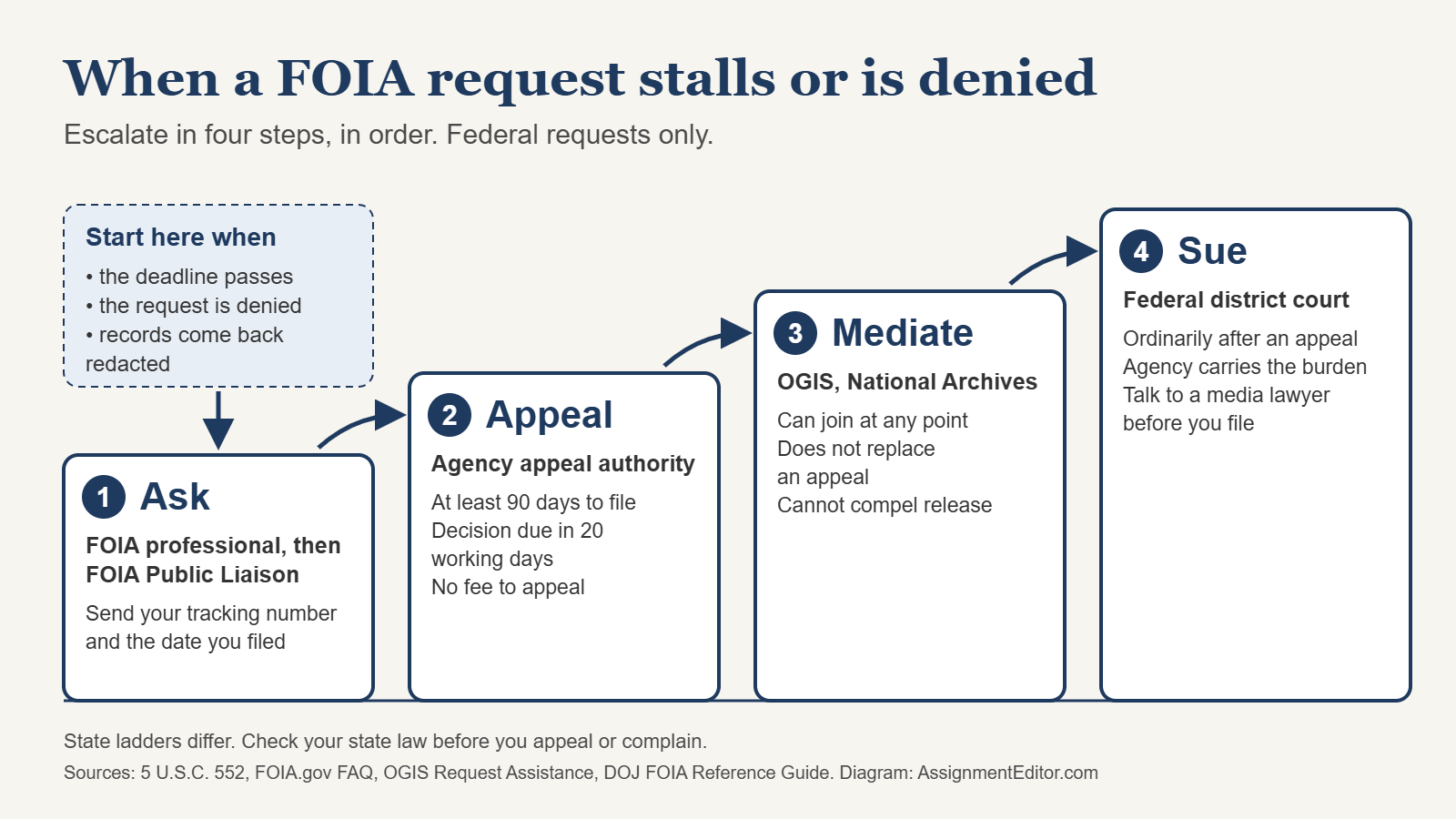
Escalate in steps: the FOIA Public Liaison, an administrative appeal, OGIS mediation, then federal court.
| Step | Who | What the source says | What to send |
|---|---|---|---|
| 1. Ask | The FOIA professional on your request, then the agency’s FOIA Public Liaison | The liaison explains the process, helps reduce delays and helps resolve disputes, per the FOIA.gov FAQ | Your tracking number and the date you sent the request |
| 2. Appeal | The agency’s designated appeal authority | The appeal window is not less than 90 days after an adverse determination, and the agency must decide within 20 days, excluding weekends and legal public holidays, per 5 U.S.C. 552(a)(6)(A). No fee applies, per the FAQ | A letter or email saying you appeal the decision. Follow the denial letter |
| 3. Mediate | OGIS at the National Archives | OGIS may become involved at any point. It does not enforce FOIA, compel release or replace an appeal, per its assistance page | Your tracking number, request, agency response, appeal and appeal response |
| 4. Sue | A federal district court | The DOJ guide says you ordinarily must file an administrative appeal first. The court decides de novo and the burden is on the agency, per the statute | Talk to a media lawyer first. The statute lets a court award fees to a requester who substantially prevails |
The court details come from 5 U.S.C. 552(a)(4)(B) and (E) and the DOJ guide. OGIS also asks you to try the agency’s FOIA Requester Service Center, FOIA Public Liaison and the appeal process first, on its assistance page. For case law on exemptions and litigation, use the DOJ Guide to the Freedom of Information Act. For federal court dockets, see the Crime, Courts and Law guide.
Boundary: the four steps above apply to federal requests. State ladders differ in who hears the complaint. The Illinois statute points requesters to the Public Access Counselor in its voluminous-request rule. The Texas AG poster says to send complaints about overcharges to the Attorney General. It says complaints about other possible violations may go to the county or district attorney where the governmental body, other than a state agency, is located. Read heading IV.D in your state’s RCFP chapter before you choose.
How do you track requests?
Log the exact text sent, the date, the tracking number and each deadline with its legal source.
Federal agencies must give you a way to check status. The statute requires a telephone line or Internet service that reports the date received and an estimated completion date, per 5 U.S.C. 552(a)(7). The USCIS page says to check status online with the FOIA control number in your receipt message.
Use one row per request. The log fits any jurisdiction, but the deadline rules in it differ by law.
| Field | Why you log it |
|---|---|
| Your own request ID | Ties your notes, drafts and copies together |
| Agency, component and law cited | Shows which clock and which appeal path apply |
| Exact text sent, date, method | Proof of what the agency received |
| Agency tracking number or control number | OGIS asks for it when you request assistance |
| Deadline, rule and statute section | Federal 20-day or your state’s rule, with the source |
| Extension or pause notices | These change the date |
| Fee estimate and your fee limit | Shows whether you agreed to charges |
| Follow-up dates and replies | Supports an appeal or an OGIS request |
| Records received, pages, exemptions cited | Feeds the verification step below |
| Next action and date | Keeps the request from stalling in your inbox |
The Local News Resources guide has a shorter log for local records. Use this one when a request may reach an appeal.
How do you verify what comes back?
Treat released records as evidence to check, not proof, and read every redaction label before you quote the record.
Agencies must show you what they cut. The statute says the amount of information deleted and the exemption used shall be indicated on the released portion, unless showing it would harm a protected interest, and at the place of the deletion if technically feasible, per 5 U.S.C. 552(b). FOIA.gov lists nine exemptions and three exclusions, and says the agency will tell you the specific exemption it applies.
An agency may withhold information only if it reasonably foresees harm to a protected interest or if law prohibits disclosure, and it must consider partial release, per 5 U.S.C. 552(a)(8). In a denial, the agency must make a reasonable effort to estimate the volume of denied material unless the estimate would harm a protected interest, per 5 U.S.C. 552(a)(6)(F).
Boundary: the labels below are federal exemptions. State laws use their own exemption lists, which part II of each RCFP chapter covers.
Read common labels this way:
| Label | What FOIA.gov says it covers | Follow-up question to ask |
|---|---|---|
| Exemption 4 | Confidential or privileged trade secrets or commercial or financial information | Which company supplied it, and was it submitted in confidence? |
| Exemption 5 | Privileged communications within or between agencies | Was the record created less than 25 years before your request? FOIA.gov gives that condition for the deliberative process privilege |
| Exemption 6 | Information that would invade another individual’s personal privacy | Can the agency segregate names from the rest of the record? |
| Exemption 7(C) | Law enforcement information that could be an unwarranted invasion of privacy | Is there a public record, such as a court file, that names the same people? |
The first column and the second column come from the FOIA.gov FAQ. The third column is desk practice, not legal advice.
Reporting checks
- Open the record and read its date, author, recipient and definitions.
- Compare the records you received with the records you described. Note anything missing.
- Count the redactions. Write down the exemption cited at each one.
- Ask for the volume estimate when pages are withheld in full.
- Search FOIA.gov and the agency FOIA library for earlier releases on the same subject.
- Find a second source before you publish, using the Journalist Toolbox steps.
- Have an independent specialist read technical records, and vet that person through Find Experts and Sources.
- Weigh privacy before you name private individuals, using the Editorial Standards.
- Give the people named in the record a real chance to respond.
- Save the letter, the records and your log together.
Next step: Journalist Toolbox
This page explains how reporters use public records laws. It is a research guide, not legal advice.
Sources
- FOIA.gov: How do I make a FOIA Request?
- FOIA.gov: Frequently Asked Questions
- FOIA.gov: Freedom of Information Act statute, 5 U.S.C. 552
- FOIA.gov: Identify an agency to request from
- FOIA.gov: Search government websites
- FOIA.gov: Reports
- DOJ Office of Information Policy: Department of Justice FOIA Reference Guide
- DOJ Office of Information Policy: Guide to the Freedom of Information Act
- National Archives, OGIS home
- OGIS: Things Journalists Ought to Know About FOIA
- OGIS: Request OGIS Assistance
- DHS: Steps to File a FOIA Request
- USCIS: Request Records through the Freedom of Information Act or Privacy Act
- HHS Office of Inspector General: FOIA
- Reporters Committee for Freedom of the Press (Advocacy): Open Government Guide
- Reporters Committee (Advocacy): Introduction to the Open Government Guide
- Reporters Committee (Advocacy): Legal Hotline
- Reporters Committee (Advocacy): California chapter
- Reporters Committee (Advocacy): Florida chapter
- Reporters Committee (Advocacy): Illinois chapter
- Reporters Committee (Advocacy): Texas chapter
- National Freedom of Information Coalition (Advocacy): FOI Hotlines
- National Freedom of Information Coalition (Advocacy): State Sample FOI Request Letters
- National Freedom of Information Coalition (Advocacy): State Law Resources
- USAGov: State and local governments
- California Legislative Information: Government Code 7922.535
- Florida Legislature: Chapter 119, Florida Statutes
- Illinois General Assembly: Freedom of Information Act, 5 ILCS 140
- Texas Attorney General: The Public Information Act, Rights of Requestors
- Texas Legislature: Government Code chapter 552, Public Information
Sources
- in writing and reasonably describe the recordsfoia.gov
- federal executive-branch agencies onlyjustice.gov
- Office of Government Information Services (OGIS)archives.gov
- Freedom of Information Actilga.gov
- Texas Attorney Generaltexasattorneygeneral.gov
- Chapter 119 of the Florida Statutesleg.state.fl.us
- Reporters Committee for Freedom of the Press (RCFP)rcfp.org
- DHSdhs.gov